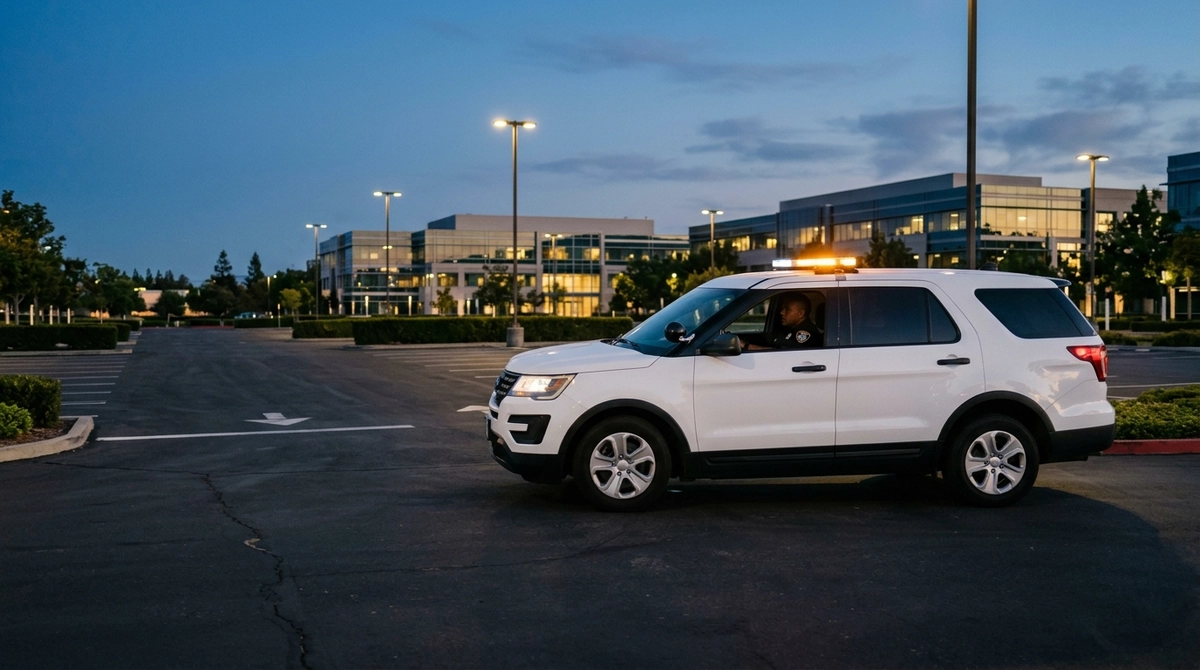
Mobile Security Patrols in San Jose and the Bay Area
Marked-vehicle patrols that check your property at irregular intervals, log every stop, and report back in writing. Unarmed, licensed, and dispatched around the clock.
Mobile security patrols in San Jose give property managers, business owners and HOA boards a licensed, uniformed presence that drives to your site, checks it, and moves on to the next stop. They suit properties that need regular eyes on them but do not justify paying for a guard standing in one place all night.
Starnet Security Inc is a California-licensed Private Patrol Operator (BSIS PPO #121618) based in Fremont, serving San Jose and the greater Bay Area with 24/7 dispatch. Our patrol officers are unarmed. They observe, deter, verify and report, and they call police or fire when a situation needs it.
This page explains what a patrol program is, how we run one, what is specific to San Jose and the South Bay, and how to compare providers. Each topic links to a deeper guide, and you can reach us any time at (669) 322-1827.
What you get with mobile security patrols
- Licensed Private Patrol Operator, BSIS PPO #121618
- GPS-monitored patrol officers and vehicles
- Digital patrol reports after each visit
- 24/7 dispatch for San Jose and the Bay Area
- Written post orders written for your specific site
- Unarmed officers trained to BSIS standards
What mobile patrols are, and who needs them in San Jose
A mobile patrol is a security officer in a vehicle who visits one or more properties on a planned but unpredictable schedule. At each stop the officer walks the exterior, tries doors and gates, checks lighting and fencing, looks for people who should not be there, and records what they find. Between stops the vehicle itself is a visible signal in the neighborhood.
The model fits the way much of the South Bay is built. Santa Clara County has large tilt-up office and R&D campuses, light-industrial parks along corridors such as North First Street and Monterey Road, strip retail with big surface lots, and thousands of apartment and townhome communities. Many of these are empty or quiet after 6 p.m., which is exactly when break-ins, loitering, dumping and vehicle crime tend to happen.
Mobile patrols are a strong match for these customers:
- Office, flex and industrial buildings that are unoccupied nights and weekends. See commercial property patrols.
- Vacant buildings, closed storefronts, and lots waiting on a sale, lease or redevelopment. See vacant property patrols.
- Businesses whose alarm company needs someone to physically check the site when a sensor trips. See alarm response patrols.
- Apartment communities, HOAs and gated neighborhoods that want after-hours rounds of parking areas, garages and common spaces.
- Construction yards and parking lots that need visits rather than a fixed post.
How Starnet deploys a patrol program
A patrol only works if it is specific to your property. We do not hand a driver a map and wish them luck. A program is built in a few steps.
Site walk and risk review. We look at how the property is laid out, where people enter, which doors and gates matter, where cameras and lighting are weak, and what has already gone wrong. For a business park that may be roll-up doors and loading docks. For an HOA it is usually garages, mailrooms, pool gates and guest parking.
Post orders. Everything we learn becomes written instructions for the officer: which checkpoints to visit, what to inspect at each, who to call, which tenants have approved after-hours access, and what the officer must never do. Post orders are the document that separates a patrol from a drive-by.
Briefing. Before an officer takes the route, they are briefed on the site and the orders. Changes are communicated through dispatch, so a new officer covering a shift gets the same instructions as the regular one.
GPS and digital reports. Patrol vehicles and officers are GPS-monitored, so a supervisor can see where a unit is and confirm that stops are made. After each visit the officer files a digital report with times, observations and any incident details, so you can read what happened without calling to ask. Our guide to what a security patrol report should include shows what good reporting looks like and what to demand from any vendor.
Supervision and adjustment. Dispatch is staffed 24/7, and supervisors review activity. If reports show repeated trouble at the rear dock at 2 a.m., the route and timing can be changed. A patrol program should get sharper over time, not run on autopilot.
Unarmed officers, licensing and training
In California, a company that provides uniformed patrol or guard services must hold a Private Patrol Operator license from the Bureau of Security and Investigative Services (BSIS). Starnet Security holds PPO #121618, and you can look up any license holder on the BSIS website before you sign.
Individual officers need a registration, commonly called a guard card. Under Business and Professions Code section 7583.6, a new guard completes a course on the power to arrest and appropriate use of force before being assigned to a post, followed by additional security officer skills training within set timeframes, for a total initial requirement of 40 hours. Our training is aligned with BSIS requirements.
Our patrol officers are unarmed and we do not provide armed guards or bodyguard services. For most vacant, commercial and residential patrol work this is the right design: the officer's job is to be seen, notice problems early, and bring in police, fire or your alarm company with accurate information.
San Jose and Bay Area specifics that shape a patrol
Several local realities affect how a route should be planned.
- Distance and traffic. Highways 101, 87, 280 and 880 and the 237 corridor can turn a short hop into a long one at commute hours. Routes should be built around real drive times, with sites grouped by geography rather than by client.
- Large, open lots. Many San Jose retail centers and business parks have wide surface parking and several access points. Patrols spend much of their time on vehicle-related risks such as break-ins, abandoned cars, and after-hours gatherings.
- Vacant and transitional property. Redevelopment is constant in the South Bay. Buildings sit empty between tenants or ahead of demolition, and they attract trespassing, metal theft and unpermitted occupancy. Vacant buildings also carry fire risk, which is why patrol reports often note open doors, broken windows, debris and signs of someone sleeping inside.
- Multi-agency response. San Jose Police and the San Jose Fire Department handle emergencies within the city, but the Bay Area is a patchwork of cities and the county. A patrol officer who knows which agency covers which address saves time when making a call. Alarm rules and permit requirements differ from city to city, so ask your alarm company or the city what applies to your address.
- Weather and seasons. The dry summer and fall raise fire concerns around vacant lots and hillside edges, while winter storms bring downed fences, water intrusion and blocked drains that a patrol can spot early.
Patrol or guard? Choosing the right level of coverage
A mobile patrol is not the answer for every property. A site with constant foot traffic, controlled access, or a high-value asset that must be watched continuously usually needs an on-site officer. Our comparison of mobile patrol vs on-site guard walks through the tradeoffs and shows where a hybrid, such as a guard during business hours and patrols overnight, makes sense.
If you are not sure, tell us about the property and what worries you most. We will say plainly whether a patrol covers it.
How to compare patrol providers
Patrol contracts are easy to sell and hard to judge from a brochure. Use this checklist when comparing a security guard company in San Jose:
- License. Ask for the PPO number and verify it with BSIS. Check that it is active.
- Insurance. Request a certificate of insurance and confirm the coverage fits your lease or HOA requirements.
- Proof of the visit. Ask how the company proves a patrol happened: GPS tracking, checkpoint scans, timestamped reports.
- Report quality. Request a sample report. If it says only "all clear", expect little value.
- Randomized timing. A predictable schedule teaches intruders when to come.
- Supervision and escalation. Who answers at 3 a.m., and what happens if an officer calls out?
- Contract terms. Read the length, cancellation terms and any extra charges for incident response or additional stops.
- Cost factors. Price depends on the number of stops, the time spent at each, the hours covered, route length and any special tasks. Beware of quotes that skip these questions.
How to get started
Call (669) 322-1827 or send a quote request. Give us the address, what the building is used for, the hours you want covered, and any past incidents. We will talk through the site, recommend a patrol pattern, and put the terms in writing.
We can often arrange same-day coverage when staffing allows, which matters after a break-in or when a building suddenly becomes vacant. Whether you start with a short trial period or a standing contract, the post orders and reporting format are set up before the first shift.
More on mobile security patrols
- Commercial Property PatrolsCommercial property patrols in San Jose for offices, retail centers and industrial parks. Licensed, unarmed, GPS-monitored with digital reports. Call today.
- Vacant Property PatrolsVacant property patrols in San Jose for empty buildings, closed stores and lots. Licensed unarmed officers check, log and report every visit. Get a quote.
- Alarm Response PatrolsAlarm response patrols in San Jose: a licensed officer checks your property when the alarm trips and reports what they find. Unarmed, 24/7 dispatch.
Guides and resources
Mobile Security Patrols FAQ
What does a mobile security patrol do?
A patrol officer drives to your property, walks the exterior, checks doors, gates, lighting and fencing, looks for trespassers or damage, and files a report. Visits happen at varied times so patterns are hard to predict. The officer calls police, fire or your alarm company if something needs a faster response.
Are your patrol officers armed?
No. Starnet Security provides unarmed officers only and does not offer armed guards or bodyguards. Patrol officers deter, observe and report, and they contact law enforcement or emergency services when a situation calls for it.
How do I know the patrol actually visited my property?
Officers and vehicles are GPS-monitored, and each visit is documented in a digital report with times and observations. You can review those records instead of relying on trust. Ask any provider you consider how they verify visits and request a sample report.
Is a mobile patrol cheaper than a stationed guard?
Often, because one officer can cover several stops rather than one post. The final cost depends on how many visits you need, how long each takes, the hours covered and the route. We quote after learning about your site, so you pay for the coverage you actually need.
Can you patrol a vacant building or lot?
Yes. Vacant sites are one of the most common patrol assignments. Officers check for forced entry, dumping, squatters, fire hazards and damage, and report each finding. Details are covered in our vacant property patrol guide, and we can start quickly when staffing allows.
What areas do you cover?
We serve San Jose and the greater San Francisco Bay Area from our base in Fremont, with 24/7 dispatch. Tell us your address when you call (669) 322-1827 and we will confirm coverage and how routes would be arranged around it.
Do patrol officers have to be licensed?
Yes. Patrol companies need a BSIS Private Patrol Operator license, and individual guards must hold a registration after completing required training, including pre-assignment instruction on arrest powers and use of force. You can verify a license on the BSIS website before hiring.
Get a patrol plan for your San Jose property
Tell us the address, the hours you need covered and what concerns you. We will recommend a patrol pattern and quote it in writing.